A branch and town page hierarchy
Each branch owns its own town pages rather than sharing one generic regional list.
Who we build forPick the roofing business you run
ServicesHow the site gets built and found
The offerWhat it costs and what you get
MoreReading, answers and a person to talk to
Theme
Accent
Saved on this device only.
A multi-location roofing website needs a clear structure that separates branch, or crew territory, from service, since a homeowner needs to land on the page for their specific location without every location page reading like a copy of the last.
What it costs
A roofing company with two or three branches often ends up with either one generic page trying to represent every branch, or several nearly identical branch pages that read as duplicate content to a search engine and to a person comparing them. Neither works. The fix is a structure where each branch page carries genuinely distinct information: its own phone number if applicable, its own crew lead or manager, its own specific service area towns, and its own local project photos.
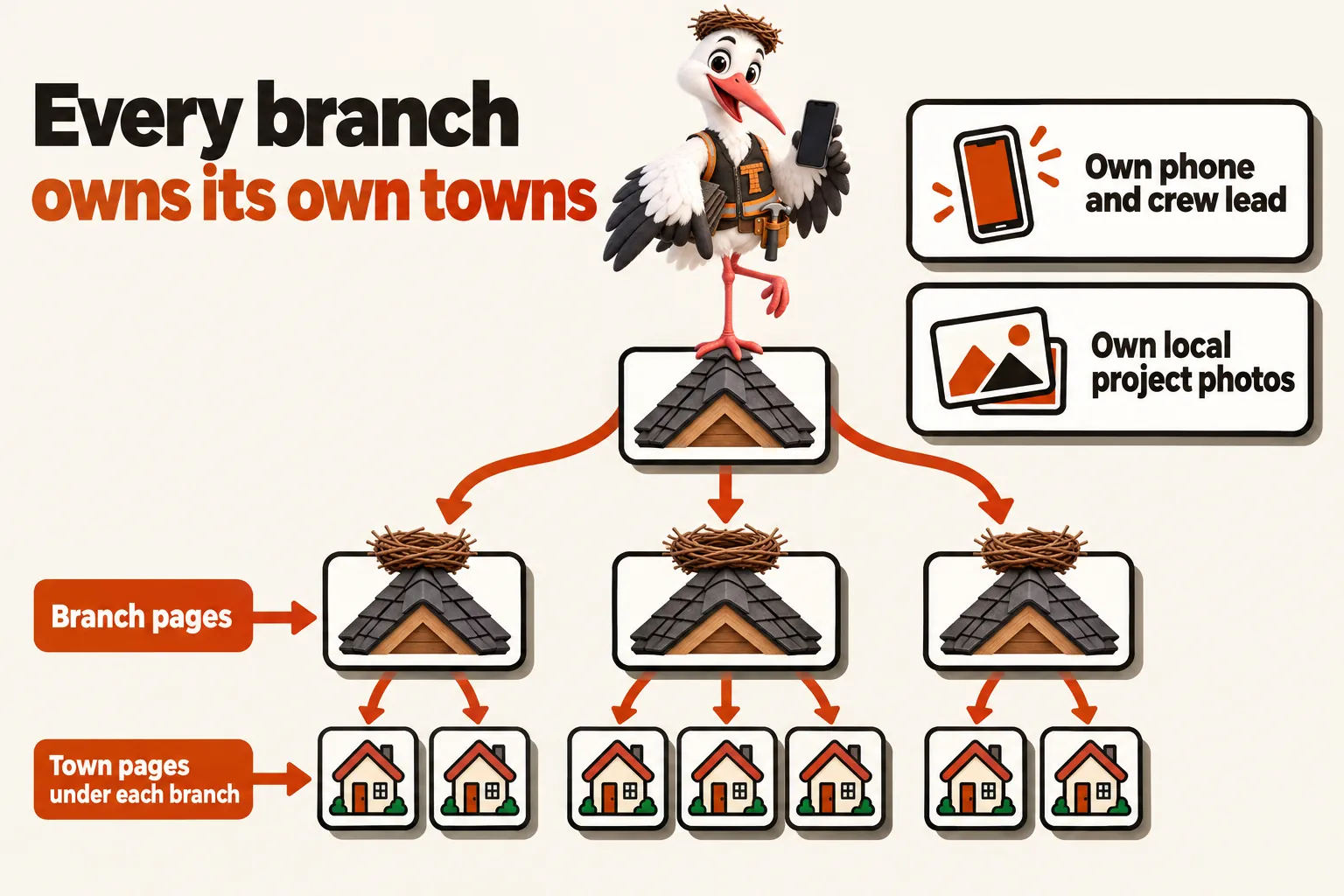
Each branch owns the town pages within its actual service radius, so a homeowner searching for a specific town lands on a page that ties back to the branch actually covering it, rather than a head-office page with no local specifics. This also keeps the site's internal structure honest about which branch does which work, which matters for both search engines and for your own dispatching.
Branch pages are written distinctly rather than templated with only the town name swapped, each carries its own genuinely local information, and canonical tags are set correctly so search engines understand which page is authoritative for which area, avoiding the internal competition that near-duplicate pages cause.
Each branch owns its own town pages rather than sharing one generic regional list.
Real, specific copy per branch rather than a template with the location name swapped.
Set up so search engines know which page is authoritative for which area.
Photos organized by branch so each location shows its own actual work.
Answer: everything on this page is part of every plan. Ridge adds the AI Engine, the receptionist, chat widget, missed-call text back and appointment booking, and Peak adds the Content Engine on top of that.
Deck
$127/ month
The website, built and managed: town and service pages, gallery, forms, hosting and 2 articles a week. Live in 7 days.
Ridge
$267/ month + usage
Everything in Deck, plus the AI Engine answering calls, chat and texts, and booking appointments. Live in 10 days.
Peak
$647/ month
Everything in Ridge, plus the Content Engine: 3 articles a week plus social posts and reels. Live in 15 days.
Every plan carries the $697 build fee, invoiced only after your site is live and approved, and 5 revisions a month completed within 2 to 5 working days. See the full plan comparison.
Answer: the change owners notice first is not the design, it is that the site starts producing inquiries they can act on.
Jocelyn Castleton
Office administrator, re-roofing and insulation contractor
Cedar Rapids, IA
I appreciated being asked to separate new roof repair visits requests from ongoing conversations. Visitors choose what they are doing first, and each choice leads to a fit-for-purpose form. Our inbox finally reads like the conversations it actually contains.
Inquiry categories and guided navigation for roof repair visits
Local roofing repair crew Fargo, North Dakota
20 working days
Storm damage roof repair specialists Columbia, South Carolina
25 working days
Domestic roofing and repairs firm Frederick, Maryland
10 working days
Usually not. One domain with a clear branch and town structure consolidates search authority, while separate domains split it and triple the work. We confirm the right structure for your setup during onboarding.
Each branch page is written with its own local information: its crew or manager, its towns, its projects and its contact routing. Canonical tags then make the hierarchy explicit so pages do not compete with each other.
Yes, if that is how you dispatch. Branch-specific contact routing is set up during onboarding to match how your team already works.
One page owns the town, and it routes to whichever branch covers it. Two pages for one town on the same domain compete with each other, which costs you both.
Leads carry the branch and the town into your CRM, so whatever reporting you already run can split by either. We do not replace your reporting tool.
Usually no. One domain with a clear branch and town page structure underneath it is typically stronger than splitting locations across separate domains, since it consolidates search authority in one place. We confirm the right structure for your specific setup during onboarding.
Each branch page is written with genuinely distinct, local information rather than a shared template with the name swapped, and canonical tags are set so search engines understand which page represents which location.
Yes, if your business operates that way. We set up branch-specific contact routing during onboarding to match how your dispatching actually works.
Ten comparison pages cover the other ways a roofing company can get this done, including when the other option is the better fit.
A live walk-through of the site you would get, in about 30 minutes. Plans from $127 a month, the $697 build fee invoiced only after launch, domain and hosting included.
Book a demoOr email and a person replies within one working day.
GetRoofingWebsite uses the cookies below. Necessary cookies keep the site working and cannot be turned off.
Saved on this device only. Press Esc to close.