Build it yourself
A page builder, a weekend, and an ongoing second job keeping it updated. No guarantee it stays fast as you add pages.
Who we build forPick the roofing business you run
ServicesHow the site gets built and found
The offerWhat it costs and what you get
MoreReading, answers and a person to talk to
Theme
Accent
Saved on this device only.
Built for roofing contractors
Custom-coded, 90+ PageSpeed, a page for every town and service you offer, and a storm-response mode that is ready before the storm is. One monthly fee, the $697 build fee invoiced only after launch.

Request a free roof inspection
Live inquiries
The site talks about the roofs you actually work on
What usually needs to change
Most roofing sites fail in the same five places, and each one costs a booked estimate before the visitor ever picks up a phone.
What waiting costs
Answer: a roofing site loses jobs in five specific places, and none of them show up on an invoice, which is exactly why they run for years. Here is what each one is costing while the site stays as it is.
Every call that rings out while both crews are on a roof is a homeowner dialing the next name in the results. Nothing on a static site catches it, and by evening the job is quoted by somebody else.
One page claiming a whole county cannot rank for a town-level search. Every month it stays that way is a month a directory site collects the searches for the streets your trucks are already parked on.
If you are buying clicks, a slow page means you pay for the visit and lose the visitor. The budget goes out either way; the only variable is whether the page was ready for them.
Demand for every roofer in the area spikes in the same 48 hours. A site that cannot change its front page, its banner or its form in that window is the one that gets skipped.
No new pages, no new articles, nothing dated this year. Search engines and AI assistants both read that as a business that stopped, and they rank it accordingly.
Every one of these is closed in the first build, inside 2 to 5 working days for anything you want changed after it.
Show me what changesSignature build: storm season response
A roofing site earns its keep most in storm season, when every competitor's phone rings at once. Here is the exact sequence, staged before the storm ever forms.
The banner, the shortened form and the insurance explainer page already exist on the site, sitting dormant until you need them.
Call volume is about to spike for every roofer in the area at once. Nothing on your site has to change yet, because it is already built for this.
One request through your client portal raises the site-wide banner and shortens the estimate form to an address and a phone number.
Every submission lands in your CRM by direct API, Zapier or Make. On Ridge and Peak, the AI Engine texts back a missed call within a minute.
Your team works the queue while it is hot. Once the surge passes, storm mode is turned back off as a normal revision.
The trace shows the order of the five stages and their relative intensity. It is an illustration of the sequence, not measured data.
Three ways to get a roofing website
Answer: the fastest and most complete path is a managed build that already includes speed, service area pages, storm mode and ongoing updates, so there is nothing left to hire out separately.
A page builder, a weekend, and an ongoing second job keeping it updated. No guarantee it stays fast as you add pages.
A one-time project fee, a handoff, then hourly billing for every change after that, with no roofing-specific pages built in.
Built, hosted and updated for one monthly fee from $127, with the $697 build fee invoiced only after launch.
| What matters | DIY | Generic agency | This build |
|---|---|---|---|
| Time to launch | Weeks to months, around the job | 6 to 12 weeks, often longer | 7 days from your onboarding call |
| Page for every town and service | Rare, takes ongoing effort | Sometimes, at an extra cost | Included, built during onboarding |
| Storm response mode | Not built | Not typically offered | Included on every plan |
| Ongoing updates | Whenever you find the time | Billed hourly or per project | Deck revisions included, flat fee after |
| Speed guarantee | None | Rarely offered | 90+ PageSpeed, guaranteed |
| Weekly articles | DIY writing, if any | Usually a separate retainer | 2 to 3 a week, included |
What is actually included
Answer: every plan includes fast custom-coded pages, town and service pages, a proof gallery, storm response mode, an estimate form wired into your CRM, policy pages, weekly articles and managed hosting. Ridge adds the AI receptionist, chat and missed-call text back; Peak adds the Content Engine.
Speed, and what it is worth
Answer: the site is built to hit a 90+ Google PageSpeed score on mobile and desktop, which keeps visitors who would otherwise leave, and because Google prices ad clicks partly on ad quality, and landing page experience is part of ad quality, a faster and more relevant page can lower what you pay for the same click.

Checked on an ongoing basis rather than on launch day, and fixed at no charge if a page slips below it.
Higher quality ads typically cost less per click than lower quality ads.
Google Ads Help, About ad quality
Google names landing page experience as one of the components of ad quality, so the page a click lands on is part of that equation. We will not promise you a cost per click, a percentage or a ranking, because the auction is Google's and your competition is local. What we control is the page: fast, relevant to the exact search, and ready to take the inquiry.
Source: Google Ads Help, About ad quality (accessed September 2026)
Getting found, three different ways
Answer: your site is built for all three at once. Search engines get the page structure and the technical work, answer engines get answer-first content they can lift, and AI assistants get clean, citable facts about your business. None of it is an add-on you buy later.
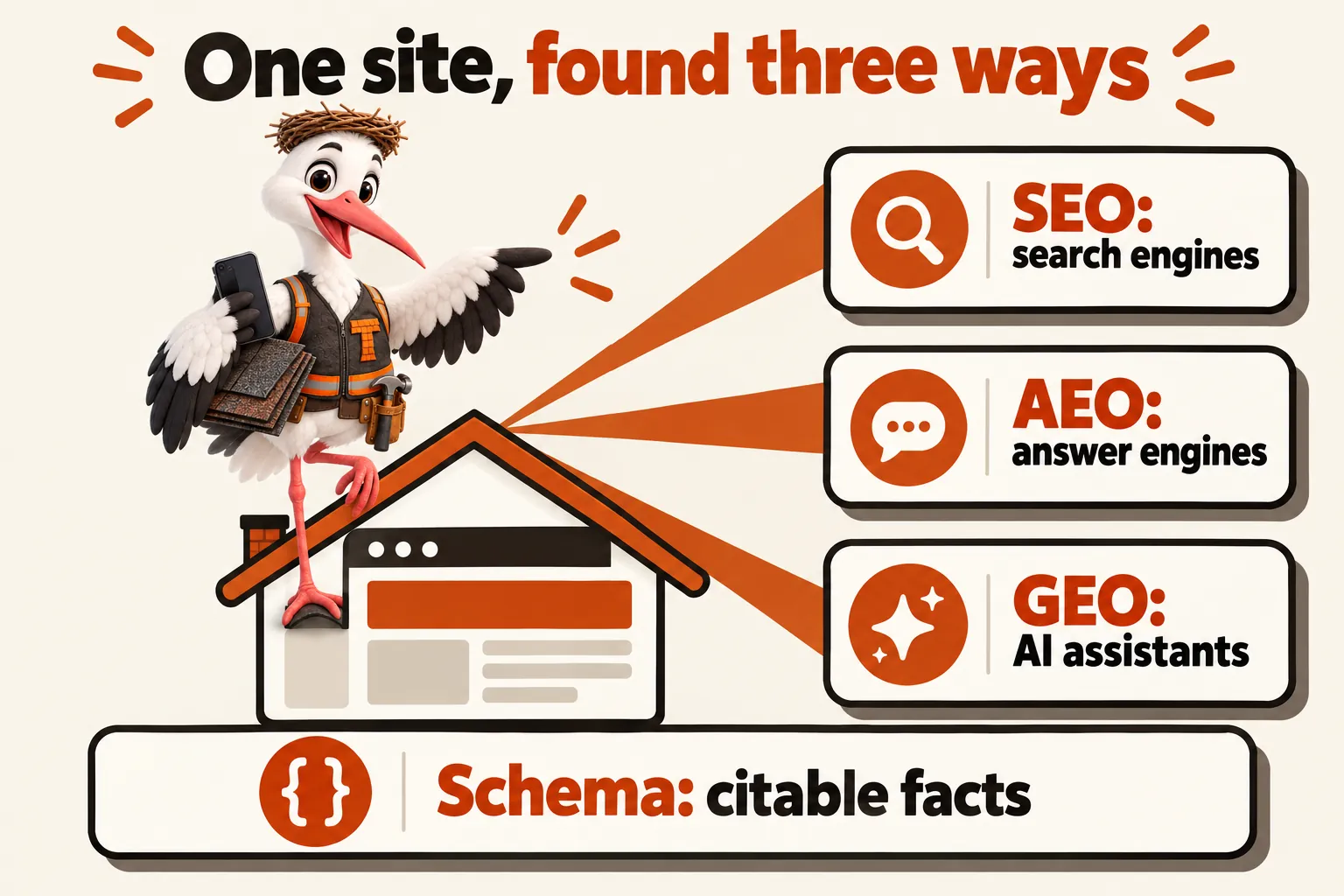
Search engine optimization here means the page architecture does the work: a page per town and service, titles and descriptions written per page, a clean heading structure, internal links between towns, services and articles, a sitemap and robots file that update themselves, and a 90+ PageSpeed score underneath all of it. Location and service area pages are part of what we build for you, which is what grows traffic from local searches rather than a single page claiming a whole county.
Answer engine optimization means every section opens with the direct answer to its own heading, questions are phrased the way a homeowner actually asks them, and FAQ blocks are visible on the page as well as marked up. That structure is what gets pulled into a featured snippet, a voice answer or an AI summary, because an engine can lift a clean 40 to 60 word answer and cannot lift a paragraph that buries the point.
Generative engine optimization means making your business easy for assistants such as ChatGPT, Claude, Perplexity and Google AI Overviews to read and quote: an llms.txt file describing the business and its key pages, consistent naming and service wording everywhere, facts stated plainly with dates, and crawler access left open rather than blocked. Nobody can guarantee a mention in an AI answer, and we do not. What we control is whether the information those systems find about you is complete, current and unambiguous.
Every page carries JSON-LD matched to what it actually is: Organization or LocalBusiness for the business, Service on each service and town page, FAQPage where questions are visible on the page, BreadcrumbList on anything below the top level, and Review markup only once you have real reviews to mark up. It is generated from the same data the page renders from, so the markup cannot drift from the visible page, which is the usual way structured data turns into a manual action.
One honest limit: nobody can guarantee that an AI assistant will name your company in an answer, and we do not. What we control is whether the information those systems find about you is complete, current and impossible to misread. See exactly what is built into every plan.
What else arrives with the site
Answer: your build ships with a full policy set, a cookie banner that really gates scripts, an accessibility statement, and the consent wording your forms and text messages need. Most roofing sites either skip these or copy them from somebody else's website, name and all.
This is built to help you meet the obligations that apply to a roofing business website. It is not legal advice and it is not a guarantee of compliance: license numbers, warranty terms and the claims you make about your work stay yours to confirm.
Written for your business and how your forms, calls and messages actually handle a visitor's details.
Your terms for the people who hire you, not a template with another company's name left in it.
A banner that genuinely holds analytics and marketing tags until a visitor agrees, rather than one that blocks nothing.
Published alongside a build made with accessibility in mind: heading structure, keyboard operation, contrast and tap targets a work glove can hit.
The opt-in line and clear opt-out that US text messaging rules expect, on any form that can trigger a message.
Carrier registration for business texting on the plans that include messaging, with carrier fees passed through at cost.
Published where a homeowner or a facilities manager looks for them, from the numbers you confirm during onboarding.
Says plainly what the site is, what any estimator on it is not, and where your professional judgment takes over.
How it works
Answer: submit the onboarding form, take one call, the site gets built, then you review and launch it, with the build fee charged only after you approve the site.
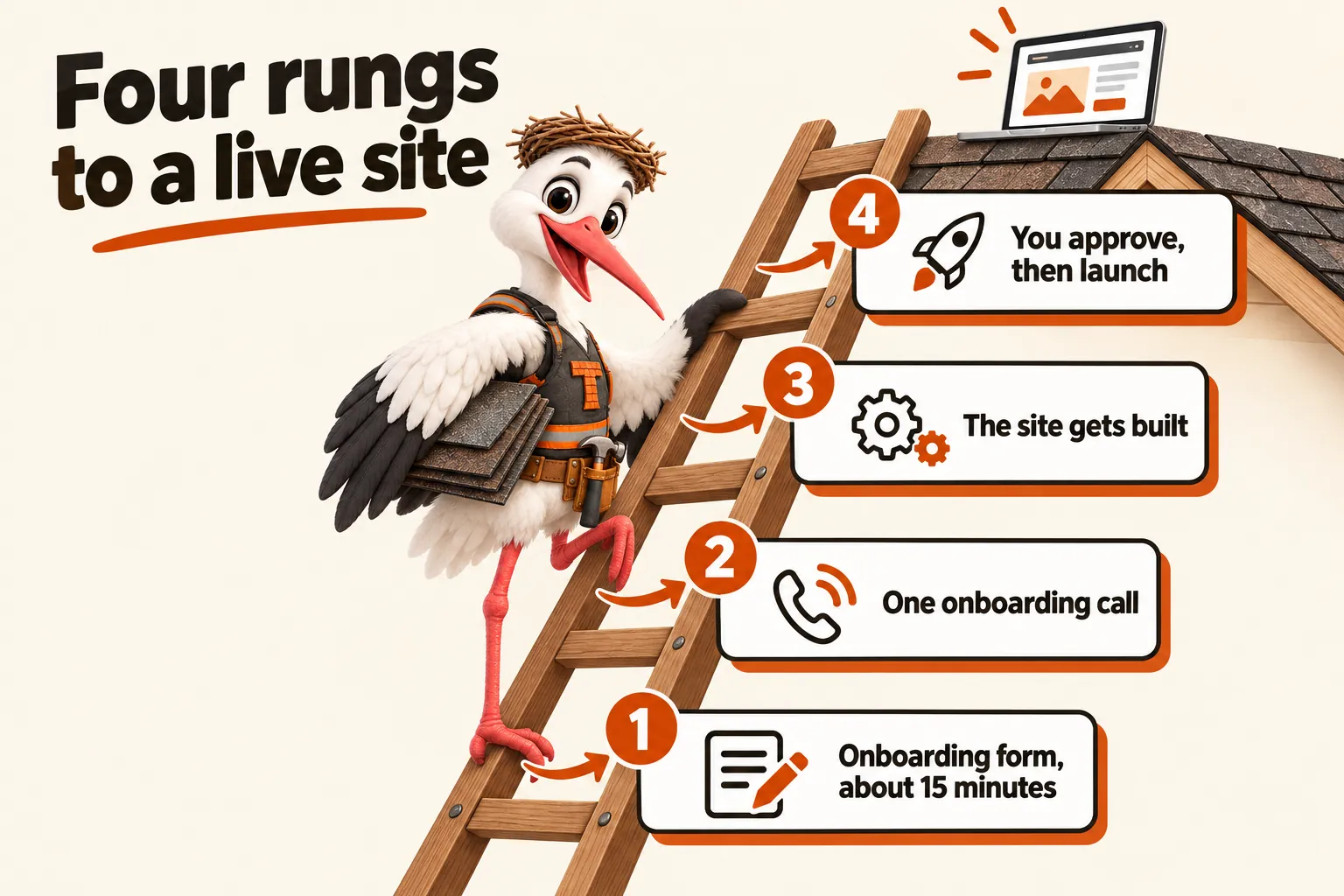
Towns, services, roof types, brand and where estimates should land. About 15 minutes, and anything missing can follow later.
We fill any gaps, confirm your CRM connection, and agree the launch date.
Custom-coded pages, service area pages, gallery and forms, live in 7 days on Deck.
Nothing goes live until you approve it. The build fee is invoiced only after that.
Who this is built for
Answer: residential, commercial, storm restoration, metal specialists and repair-and-maintenance companies each get a site built around their own buyer, not one template stretched to fit all five.
A residential roofing website earns its keep by ranking for repair and replacement searches in the exact towns you serve, then getting an address and a phone number before the visitor closes the tab.
See what changesA commercial roofing website earns its keep by giving a facilities manager or general contractor the specific membrane types, project scale and licensing information they need before they will add you to a bid list.
See what changesA storm and insurance restoration website earns its keep by being ready to flip into a rapid-response mode the moment a storm hits, when call volume for every roofer in the area spikes at once.
See what changesA metal roofing website earns its keep by educating a homeowner who is comparing metal against asphalt shingle for the first time, then converting that research into a booked estimate.
See what changesA roof repair and maintenance website earns its keep by ranking for the smaller, more frequent searches, a leak, a missing shingle, a maintenance plan, that a full-replacement-focused competitor's site ignores.
See what changesWhat owners say changed
Answer: the first message arrives with the details a reply needs, the page works on the phone a caller is holding, and the questions that used to take a phone call get answered on the site. The design comes second to all three.
See what it costsSabrina Mortimer
Site visits coordinator, tiled roof replacement contractor
Burlington, VT
Honestly, the redesign was nice, but the inquiry form is what changed our day-to-day. It collects property location, visible concern and access availability up front, so the back-and-forth we used to do by reply has largely gone. We answer properly on the first reply far more often than we used to.
Inquiry form and response workflow for roof repair visits
Alfred Wentworth
Workshop coordinator, slate roof restoration specialists
Sioux Falls, SD
My first check was simple: open the roof repair visits page on a phone and try to get in touch. The essentials are within the first screen, with an obvious way to inquire. It is far more practical than the old page when we share it with a caller.
Mobile navigation and page layout for roof repair visits
Pricing
Answer: Deck is $127 a month, Ridge adds the AI Engine, and Peak adds the Content Engine, each with the same $697 build fee charged only once your site is live.
Deck
The website, fully managed
$127/ month
plus $697 build fee, after launch
Ridge
Everything, plus the AI Engine
$267/ month + usage
plus $697 build fee, after launch
Peak
Everything, plus the Content Engine
$647/ month
plus $697 build fee, after launch
All plans include domain registration, Cloudflare hosting with SSL, CDN and DDoS protection, and a client portal from day one. All sales are final except a duplicate or incorrect charge reported within 30 days.
Guarantees, and their limits
Answer: speed and local ranking progress are guaranteed with a stated remedy, the build fee waits until you approve the site, and changes are flat-fee forever. Anything outside our control is named rather than quietly promised.

We guarantee a Google PageSpeed score of 90+ on mobile and desktop for the pages we build and host. If one falls below it because of our work, we fix it at no charge. The remedy is the corrective work, not a refund.
We guarantee your site starts ranking for local searches in your area within 3 to 5 months of launch. If it has not, we continue the search work at no additional charge until it does. We do not promise a specific position, because competition in your market is not ours to control.
The $697 one-time build fee is not taken at signup. It is invoiced once your site is live and you have told us you are happy with it, which is the whole point of charging it at that end.
5 revisions a month of any size, completed within 2 to 5 working days, then a flat fee each with no hourly billing and no cap. A site you cannot change is a brochure.
The full wording lives in the terms and conditions and the refund policy. It says the same thing there as it does here.
Where this works
Answer: we build and manage sites for roofing contractors anywhere in the United States, and the site is written for the towns you actually work. These ten states come up most, because hail, wind and reroof demand concentrate there, but nothing about the build depends on which one you are in.
Hail corridor work from Dallas to San Antonio, with insurance restoration running most of the year.
Wind uplift, tile and metal, and a permit and inspection trail buyers expect to see explained.
Dense suburban reroof demand where a town-level page beats a county-wide claim.
Spring hail seasons that turn a quiet week into a switchboard overnight.
Front Range hail plus steep-slope and snow-load work that a generic contractor template never names.
Coastal wind and inland storm damage in the same service area, sold to different buyers.
Freeze and thaw repair searches through winter, replacement searches through summer.
Older housing stock, slate and tear-off questions, and long homeowner research cycles.
Low-slope foam and tile roofs, monsoon damage, and a heat cycle that drives maintenance work.
Title 24 and fire-resistance questions alongside commercial single-ply work.

Your location pages are built for towns you genuinely serve, with real detail about the housing stock, the roof types and the permit quirks there. We do not fabricate a service area, and we do not publish an address you do not have. Thin, duplicated town pages get filtered out by search engines and they embarrass you in front of the people who read them.
How town pages are builtWhat clients tell us
Answer: the changes clients describe are practical ones: a site built from the questions callers really ask, a clear next step after pressing send, and a preparation page that does the explaining before the first call.
Joan Seagrave
Roofing service coordinator, residential roof repair contractor
Springfield, MO
They built the FAQ from our actual roof repair visits correspondence. They identified which questions belonged on the site and we checked every answer before launch. The phone calls about basic roof repair visits details have noticeably thinned out.
FAQ research and editorial review for roof repair visits
Christopher Harrington
Depot coordinator, roof leak detection and repair service
Stamford, CT
Before this, sending our roof repair visits form felt like mailing a letter into the dark. Submitters now see exactly what we will do with their request and when to expect us. It sounds minor until you add up the reassurance calls it has replaced.
Submission acknowledgment and follow-up for roof repair visits
Faris Abbasi
Call handling supervisor, rubber and felt flat roofing installer
Tacoma, WA
The preparation page for roof repair visits works because it keeps its focus. It tells people what to have ready before we speak, without demanding everything up front. We include it in our first response as standard.
Preparation guide and inquiry support for roof repair visits
Each case study sets out what the business started with, what we built, how many working days it took and what changed, with the client's own words at the end.
Domestic roofing and repairs firm Frederick, Maryland
10 working days
Roof replacement and repair firm Ann Arbor, Michigan
15 working days
Slate roof restoration specialists Omaha, Nebraska
20 working days
Proof, organized
Answer: your finished jobs are grouped by roof type and material, so a visitor comparing a shingle reroof finds a matching example in a couple of taps instead of scrolling every project you have ever done.


Send job site photos through your client portal and we sort them into the matching category, resized and compressed so the gallery stays fast even with dozens of projects.
The four images above are stock roofing photography showing how the categories are laid out. On your site they are replaced by your own finished jobs; we never present another company's work as yours.
From the blog
Answer: every plan includes weekly sourced articles about the roofing questions your buyers actually search, so the site keeps publishing after launch instead of going quiet.
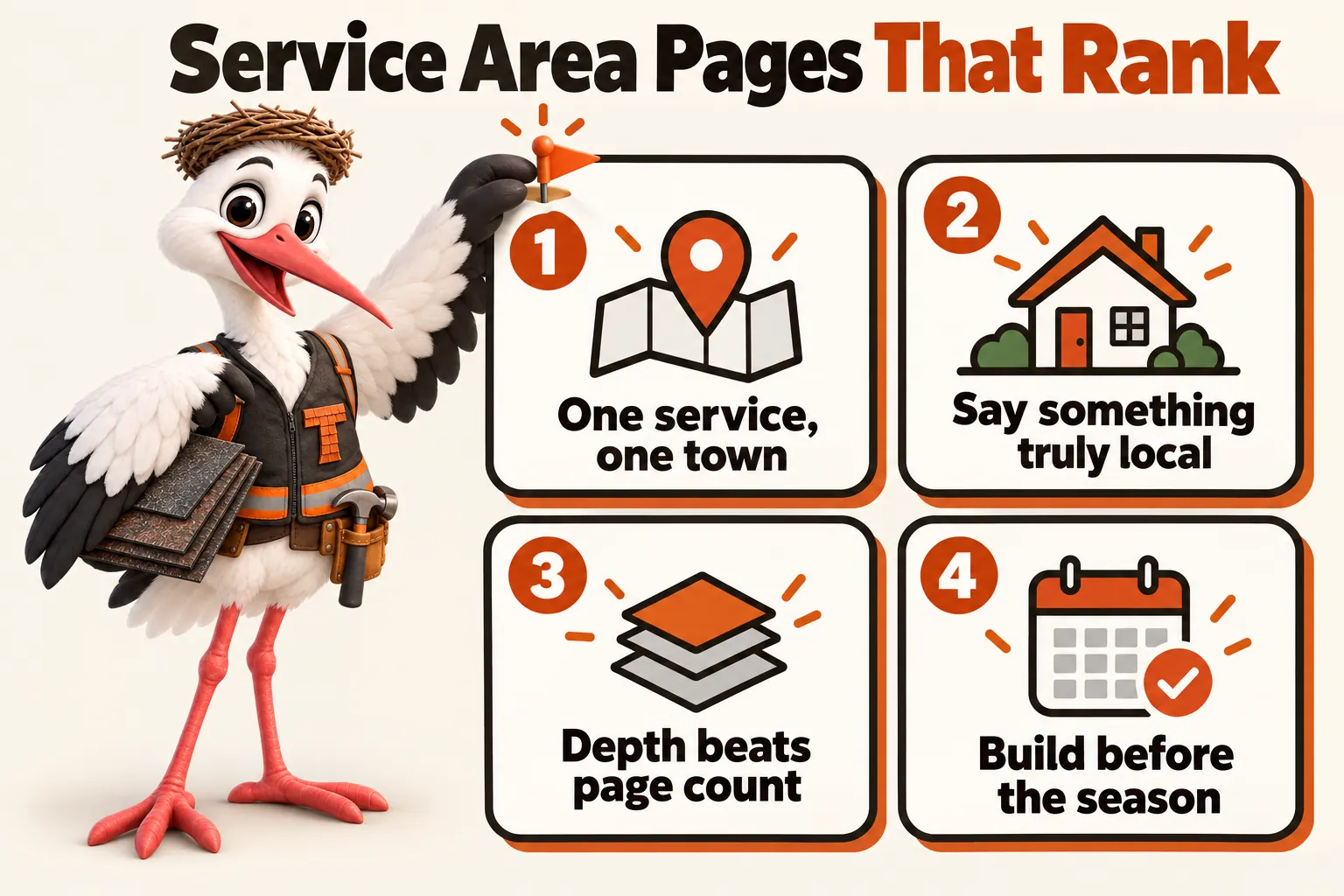
What separates a service area page that ranks from one that reads as a template: real local detail, one page per town and service, and links a crawler can follow.
September 10, 2026
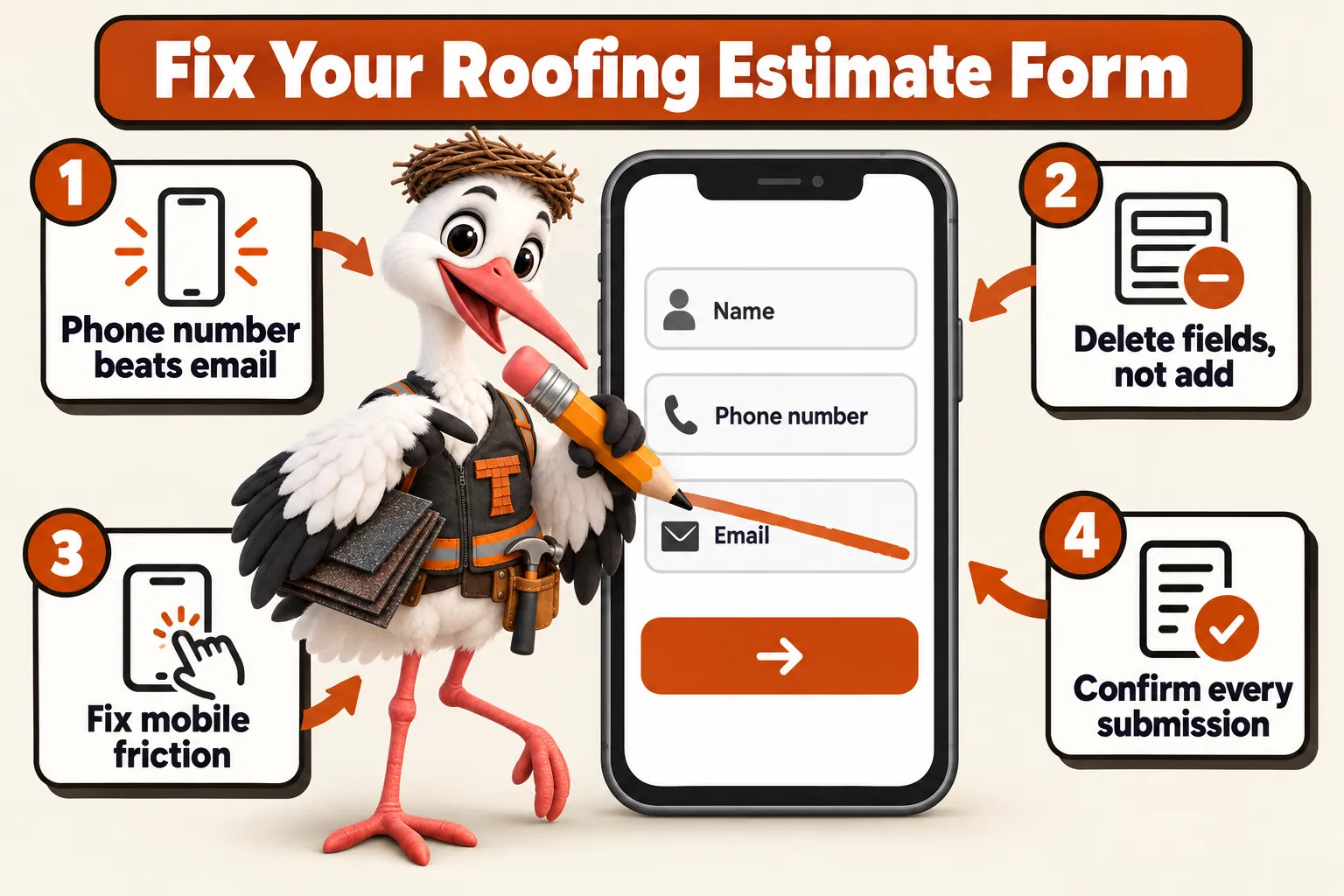
Field by field, what a roofing estimate form should ask, what it should never ask, and how the confirmation page decides whether a lead reaches a person.
September 8, 2026

A pre-season checklist for a roofing website: speed, service area pages, the insurance explainer, the shortened estimate form, and what to check after the surge.
September 3, 2026
Common questions
Answer: launch timing, revisions, hosting, domains and billing are covered here in plain terms; the full FAQ page carries every group in detail.
See all questions7 days on Deck, 10 on Ridge while the AI agents are trained on your business, and 15 on Peak with the content engine set up. The clock starts at your onboarding call, not the day you pay, so the sooner your onboarding form is in, the sooner the site is live.
No. We are a website design and management company, not a licensed roofing contractor, insurance adjuster or construction firm. Everything we publish about roofing systems, storm damage or claims is general, sourced information written for search visibility, never a substitute for your own professional judgment on a specific roof.
We guarantee a Google PageSpeed score of 90+ on the pages we build and host. Search rankings depend on many factors outside a website alone, including competition in your area and how established your business is online, so we do not guarantee a specific ranking position, but the service area pages, articles and speed work are all built specifically to compete for it.
Every build ships with a privacy policy, terms and conditions, a cookie policy with a consent banner that genuinely holds analytics and marketing scripts until a visitor agrees, an accessibility statement and a disclaimer page, all written for your business rather than copied from somebody else's site. On the plans with messaging, the consent wording and opt-out your text messages need are built into the forms and the A2P 10DLC carrier registration is filed for you. This is built to help you meet the obligations that apply to a roofing business website; it is not legal advice and not a guarantee of compliance.
It can help, and we will not promise you a number. Google Ads Help states that higher quality ads typically cost less per click than lower quality ads, and Google names landing page experience as one of the components of ad quality, so a faster page that matches the search is the part of that equation inside anyone's control. The more reliable benefit is simpler: more of the clicks you already paid for reach a page that loads, instead of leaving while it draws.
No to both, and we would rather say so plainly than take the money. We build, host, write and maintain the website. Managing a Google Business Profile, buying media and running ad campaigns are separate jobs, and plenty of our clients keep an agency for them while we run the site their campaigns point at.
Plans from $127 a month, the $697 build fee invoiced only after launch, live in 7 days.
GetRoofingWebsite uses the cookies below. Necessary cookies keep the site working and cannot be turned off.
Saved on this device only. Press Esc to close.